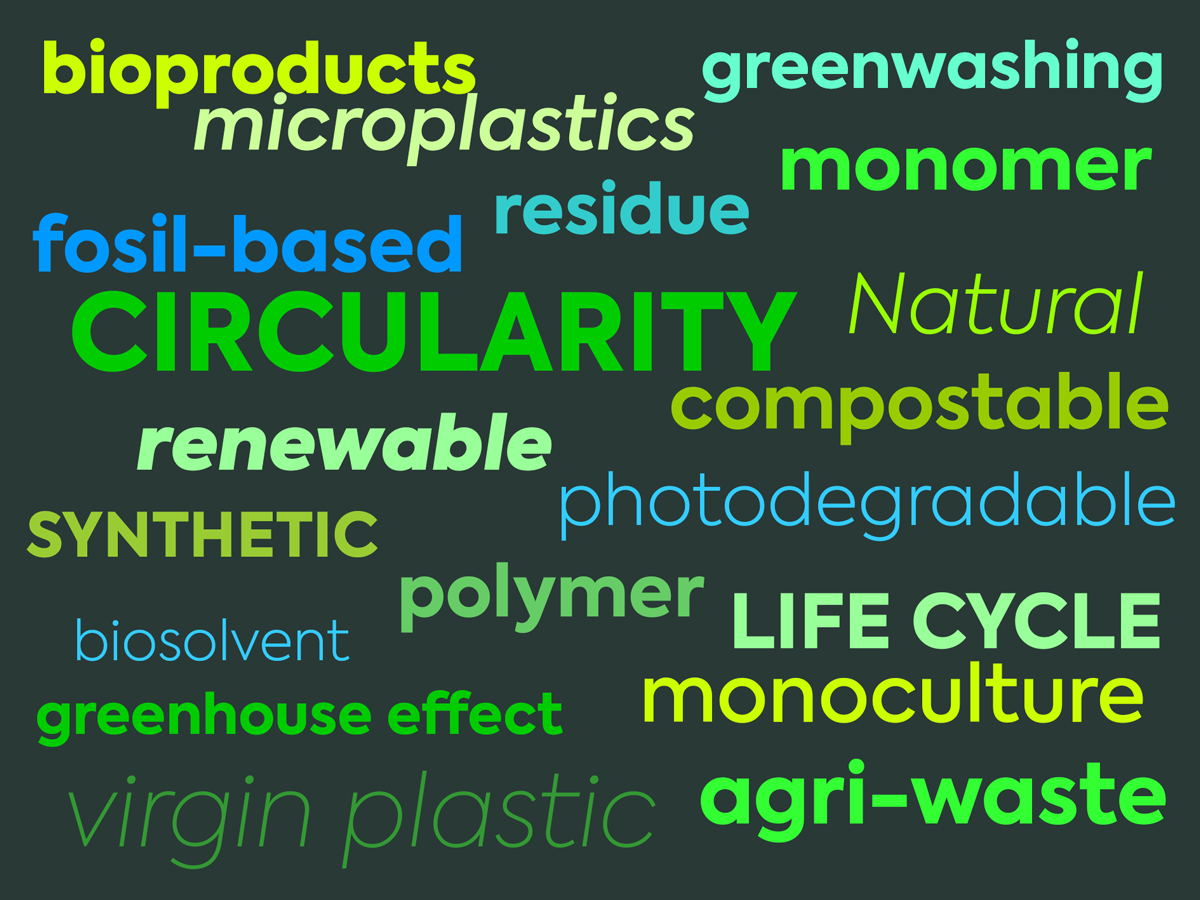
The Postplastic Glossary: new words for a sustainable world  

Do you know the difference between an Oxodegradable and a compostable material? And just what is a smart drop-in?

In the last year alone, the lexicon surrounding alternative materials has moved on rapidly.

At CirQulor, we’ve amassed definitions from trusted sources and leading organisations and popped them into a handy online glossary.

The aim is to aid understanding within organisations, clarify dialogue, and, we hope, provide much-needed continuity within a developing sector.

Who will find the glossary helpful?
It would probably be easier to ask who wouldn’t benefit. Anyone involved in materials development will find it helpful, however, the adoption of alternative materials encompasses virtually all companies, sectors and industries, across multiple supply chains, recycling systems and waste streams.

It’s also essential that policymakers and leaders use precise definitions to ensure policy and regulations are clear and watertight.

Consumers, too, will benefit from greater understanding, as we move away from generic words like ‘plastic’ to a host of new terms that, if used correctly, will allow for more informed purchasing decisions. A common language will also prevent consumers from being misled, whether intentionally or not.

Such is the need for a common language, it makes sense to define and standardize what will become an everyday lexicon.

An open, living resource
The CirQulor Postplastic Glossary is a free resource to share, cite and use.

And, as it’s a living resource that will grow and be revised as the postplastic lexicon develops, if there’s a word that you think should be included, or a definition needs to be improved, please let us know – there’s a comment box at the top of the page.
 

Related articles

20in30 title-small

CirQulor 20in30 – Podcast

Where experts answer twenty questions in thirty minutes about plastic, alternatives-to-plastic and all things circular. #3 Hair’s what’s happening! , Andrew and Zsofia Kollar – Founder of Human Material Loop – get into what is ‘waste’ and the benefits of hypo-allergic, strong as steel, climate-positive high-performance textiles from human hair!

Read more »

Plastic pollution solution? UNCTAD says; make a list…

Although there are new (some highly innovative) materials and products being developed and entering the market, a defined list of plastic substitutes does not exist (yet) The issue of plastic pollution is gaining momentum in the global effort to address climate change. And, while plastic substitutes are not an immediate

Read more »
The Impossibilities of the Circular Economy

The Impossibilities of the Circular Economy

Separating Aspirations from Reality 360dialogues  engaging graphic treatment examines circularity’s promise as a silver bullet for the planet’s problems and finds it wanting. With engaging visuals, it evaluates the claims from a scientifically informed perspective, illustrating the difference between possible and non-possible solutions for a more sustainable economy and provides a

Read more »

The Art of Invention

Let’s face it, it’s not easy to learn about alternative-to-plastic materials – often cutting-edge innovations described in the impenetrable language of the lab and the academy. But what about how we think about innovation? As IP lawyer Sara Holland’s article The Inventions so enjoyably shows, art has often been our

Read more »
Plastic waste dump aerial view

360º vision

”The amount of plastic produced in a year is roughly the same as the entire weight of humanity.”

There just aren’t enough elephants in the world for a comparison, so we’ll stick with 7 billion humans for now. The  truth is, if we want to achieve a sustainable future, we’ve a long way to go. But there are optimistic signs everywhere, green shoots that will change this planet for the better. Join us as we delve deep into a brave, new postplastic world.

Entries in this blog reference ‘CirQulor’.
This is Verdatica’s previous identity 

Latest