It’s easy to imagine a postplastic world that looks and feels just like the present, but, perhaps, with the odd alternative material here and new recycling point there. And while these topics attract the lion’s share of attention among the media and public, there is a whole area of transition to come that will be essential in achieving a more sustainable and harmonious way of life on this planet.
It’s called Circularity, and it’s going to be huge in our brave, new world.
Circularity, or the circular economy, is a broad concept that, in essence, attempts to break the current models of ‘take-make-discard’ that are damaging our planet, and replaces them with a model that completes the cycle – either returning resources used or replenishing to rebalance the damage we have already done. It’s ambitious in that the world is a complex place with multiple players, agendas and drivers.
The success of circularity is dependent on getting everyone to acknowledge that their actions and activities are part of a bigger scheme and to fundamentally change their approach to product use, reuse, and, finally, disposal.
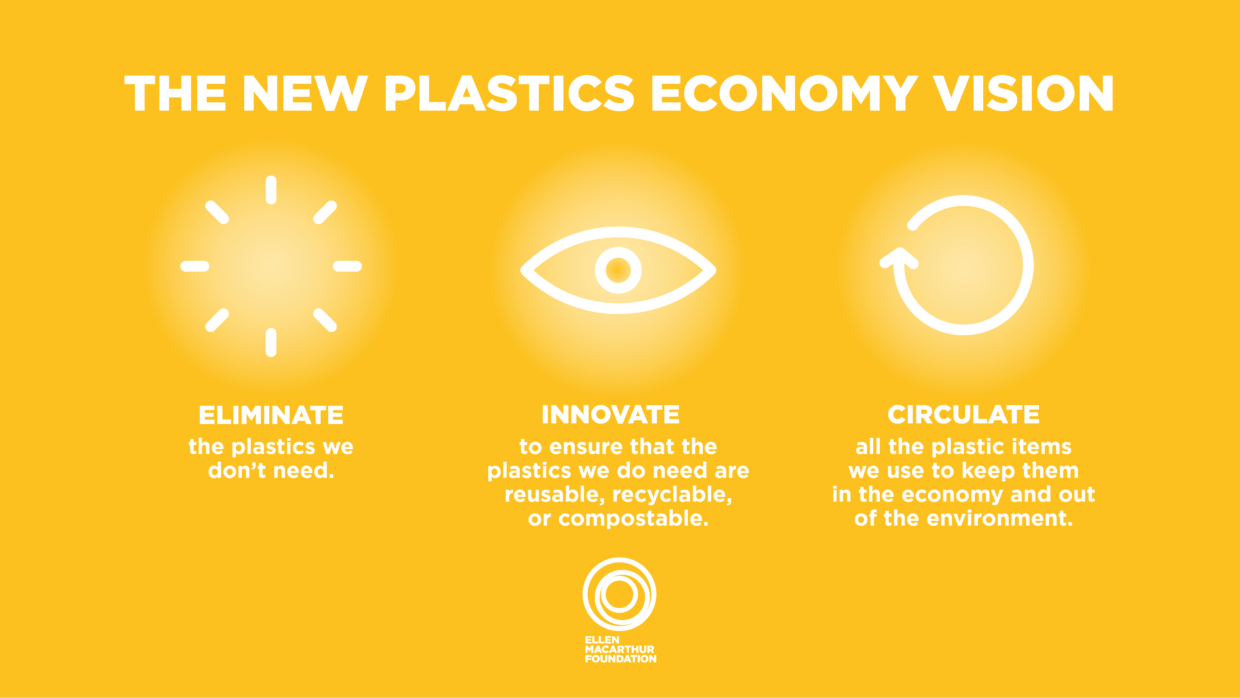
To simplify the message and help everyone focus efforts, the Ellen McArthur Foundation has developed three action points to create a new circular economy for plastic:
In our postplastic world, it will be necessary to adopt and internalize new ideas. For industry, there will need to be fundamental shifts in attitude that support circular business models. We need to rethink how products are designed, how they are used and how they are disposed of at end of life. Brands will need to consider the ‘whole of life’ of a product, from cradle to cradle, not just up to the point of sale or expiration of the warranty. An example is how some brands are starting to think of their products as a ‘service’; a concept that extends responsibility across more of the product’s lifecycle, while also providing opportunities to generate additional revenues above and beyond the sale of the product.
A major change will be the need to create products that last longer; that can be repaired easily and at reasonable cost (Right to Repair); and that can be broken down back into reusable components to create new products. The practice of building in obsolescence is wasteful of precious resources and is no longer acceptable. Indeed, brands should be doubling efforts to build it out.
We’ve only touched briefly on the subject of circularity, circular design principles, and the circular economy here, but it will be a recurring theme in this series. For every one of us, its impact will become evident in the social changes and innovations we’ll experience over time.