Government

The Impossibilities of the Circular Economy

The Impossibilities of the Circular Economy

Separating Aspirations from Reality 360dialogues  engaging graphic treatment examines circularity’s promise as a silver bullet for the planet’s problems and finds it wanting. With engaging visuals, it evaluates the claims from a scientifically informed perspective, illustrating the difference between possible and non-possible solutions for a more sustainable economy and provides a more pragmatic foundation on which …
The Impossibilities of the Circular Economy Read More »

20in30 title-small

CirQulor 20in30 – Podcast

Where experts answer twenty questions in thirty minutes about plastic, alternatives-to-plastic and all things circular. #3 Hair’s what’s happening! , Andrew and Zsofia Kollar – Founder of Human Material Loop – get into what is ‘waste’ and the benefits of hypo-allergic, strong as steel, climate-positive high-performance textiles from human hair!        Listen on …

CirQulor 20in30 – Podcast Read More »

Global Plastics Treaty: One Principle we would like to see upheld

  The Substitution Principle When an alternative material, substance or chemical becomes available it must be substituted. Substitution is costly and complex and will require incentives coupled with strict regulation. The United Nations Environmental Assembly (UNEA5) will meet in Nairobi on 28 February – 2 March 2022 to negotiate and agree on a new legally …

Global Plastics Treaty: One Principle we would like to see upheld Read More »

It’s biodegradable so it’s green, right?

A report by US market research company Dynata found that 68 per cent of consumers prefer to buy products and services from companies that are environmentally responsible. It is therefore incumbent on brands and businesses to ensure that their products are labelled correctly and accurately and that consumers aren’t misdirected. To avoid accusations of greenwashing, …

It’s biodegradable so it’s green, right? Read More »

COP26. Plastic and the CO2 Challenge

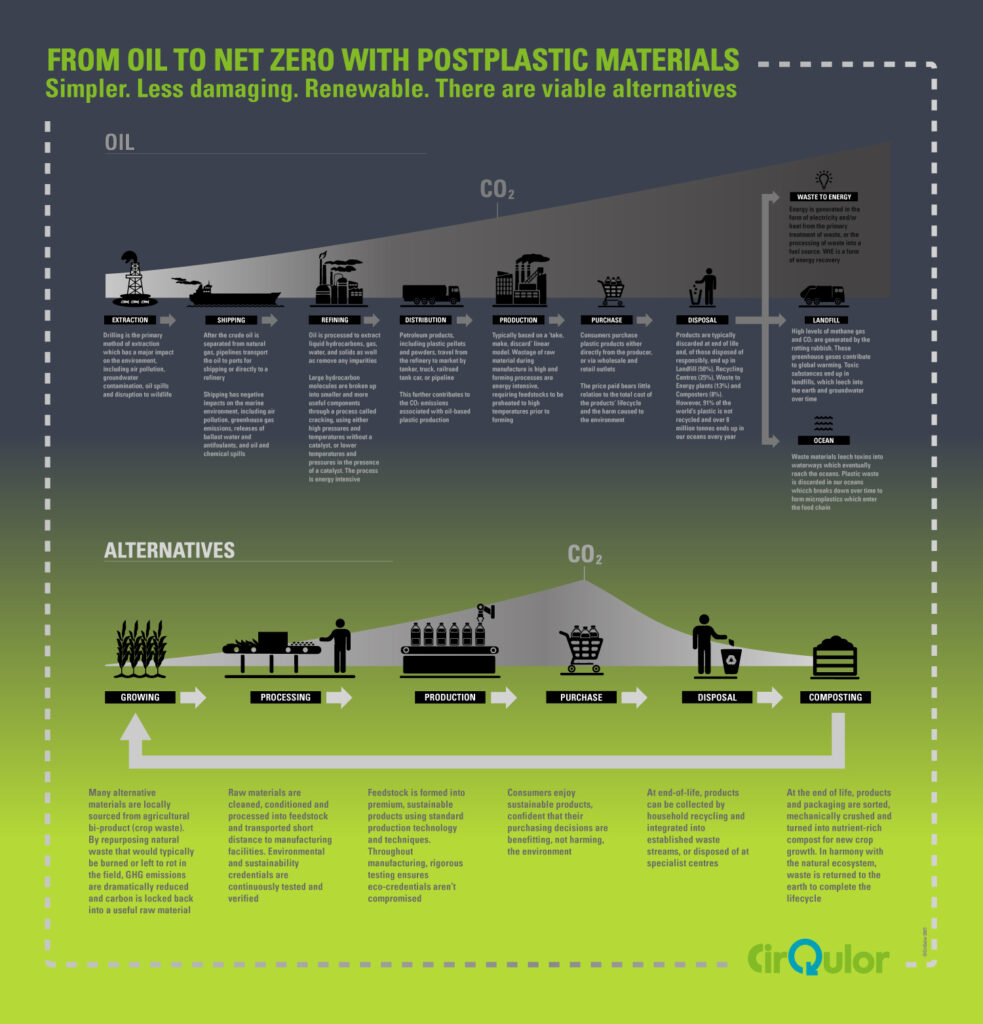
World leaders at COP26 will be looking at ways to reduce CO2 emissions to achieve their net carbon zero commitments with ambitious pathways across power generation, transport, agriculture, homes and heavy industry. However, the manufacturing sector –  and particularly plastics manufacturing – seems to have been ignored. The production of plastics currently accounts for approximately …

COP26. Plastic and the CO2 Challenge Read More »

Mind the Gap #1: Finding alternatives to Single Use Plastics

A major contributor to the environmental pollution problems we face today is what we term our ‘throw-away society’. We have become accustomed to products that are designed to have a short lifespan and which are then discarded. Manufacturers have even been accused of building in obsolescence to reduce product life. Then there are certain high-volume …

Mind the Gap #1: Finding alternatives to Single Use Plastics Read More »